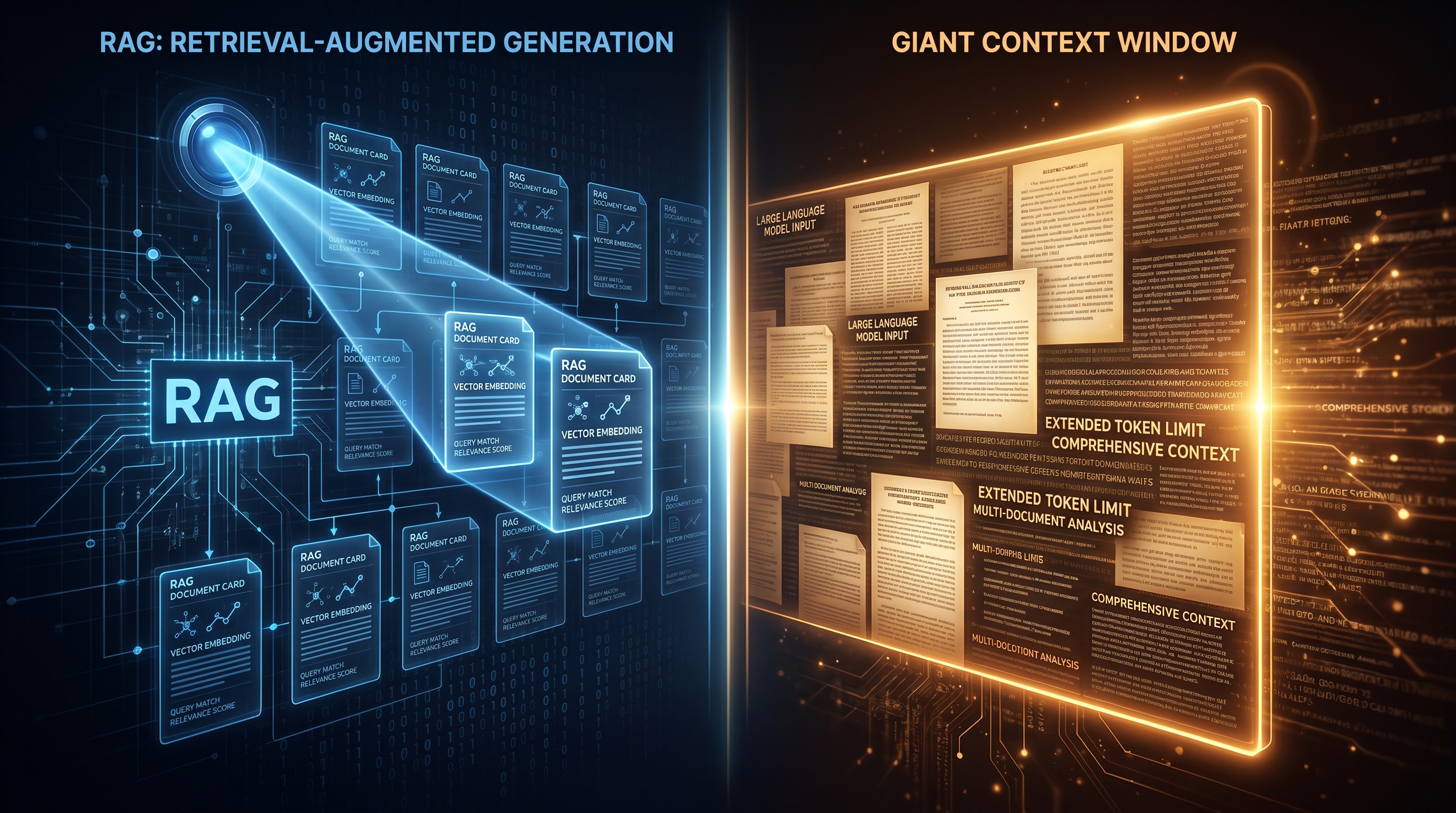
RAG vs Long Context: Economics, Benchmarks, and Hybrid Approaches (2025–2026)
Executive Summary
The expansion of context windows to 1–2 million tokens has not made retrieval-augmented generation obsolete. Instead, it has created a more nuanced cost landscape where the right architecture depends on corpus size, query volume, freshness requirements, and accuracy targets. RAG remains 10–1,250× cheaper per query at scale, but prompt caching (saving 50–90% on repeated tokens) has opened a viable middle ground for medium-scale corpora. Hybrid approaches — retrieve broadly, then reason over a medium-length context — are emerging as the dominant production pattern in 2026.
1. The 2026 Token Pricing Landscape
Context windows have grown dramatically while per-token costs have plummeted. The table below captures the current state as of Q1–Q2 2026 [1][2]:
| Model | Provider | Context Window | Input $/1M Tokens | Cost to Fill Window |
|---|---|---|---|---|
| Grok 4.1 Fast | xAI | 2,000,000 | $0.20 | $0.40 |
| Llama 4 Maverick | Meta (Together AI) | 1,000,000 | $0.27 | $0.27 |
| Gemini 3 Flash | 1,000,000 | $0.50 | $0.50 | |
| o4-mini | OpenAI | 2,000,000 | $1.10 | $2.20 |
| GPT-5.2 | OpenAI | 1,000,000 | $1.75 | $1.75 |
| Gemini 2.5 Pro | 2,000,000 | $1.25 / $2.50 (>200K) | $2.50–$5.00 | |
| GPT-5.4 | OpenAI | 1,050,000 | $2.50 / $5.00 (>272K) | $2.63–$5.25 |
| Claude Sonnet 4.6 | Anthropic | 1,000,000 | $3.00 | $3.00 |
| Claude Opus 4.6 | Anthropic | 200,000 | $5.00 | $1.00 |
| GPT-5.4 Pro | OpenAI | 1,050,000 | $30.00 | $31.50 |
The price spread is enormous: filling a 2M-token window costs $0.40 on Grok 4.1 Fast but $31.50 on GPT-5.4 Pro — a 78× difference for comparable context sizes [1]. Notably, some providers now apply tiered pricing: GPT-5.4 charges 2× for tokens beyond 272K, and Gemini 2.5 Pro doubles its rate past 200K [2].
Historical trajectory for context [1]:
- 2023: GPT-4 — 8K tokens at $30/M input. Filling cost: $0.24.
- 2024: GPT-4 Turbo — 128K tokens at $10/M. Filling cost: $1.28.
- 2025: GPT-5 — 1M tokens at $1.25/M. Filling cost: $1.25.
- 2026: Grok 4.1 Fast — 2M tokens at $0.20/M. Filling cost: $0.40.
2. RAG Cost Anatomy
A production RAG pipeline has five cost layers: embedding generation, vector storage, vector queries, optional reranking, and LLM generation. The critical insight from 2026 production data is that generation dominates 80–95% of total RAG costs [3][4].
2.1 Embedding Costs
Embedding is largely a one-time expense and has become remarkably cheap [3][4]:
- OpenAI text-embedding-3-small: $0.02/M tokens
- Cohere embed-english-v3.0: $0.10/M tokens
- Gemini Embedding 2: $0.20/M tokens
Concrete example: A 50-million-token corpus costs approximately $10 to embed with Gemini Embedding 2, and a 10-million-token corpus costs about $2 [3]. Self-hosted embedding on an L4 GPU can process 1M vectors monthly for roughly $4.40 [5].
However, embedding costs compound with data volatility. A knowledge base updating 10% of content weekly regenerates 10% of embedding costs every week. Over 12 months, cumulative re-embedding can exceed the original ingestion cost by 5–8× [6].
2.2 Vector Database Costs
Vector DB pricing varies significantly by provider and scales with both storage and query volume [4][7][8]:
| Database | 1M Vectors | 10M Vectors, 100K Queries/mo | 10M Vectors, 10M Queries/mo | 100M Vectors, 10M Queries/mo |
|---|---|---|---|---|
| Pinecone Serverless | ~$70/mo | $70–$150 | $200–$800 | $1,500–$5,000 |
| Weaviate Cloud | ~$25/mo | $100–$250 | $400–$1,200 | $2,000–$6,000 |
| Qdrant Cloud | ~$30/mo | $80–$200 | $300–$900 | $1,200–$4,000 |
| pgvector (self-hosted) | Server cost | $200–$400 (fixed) | $200–$800 | $800–$2,500 |
Key hidden cost: Pinecone Serverless charges $0.33/GB/month for storage and $8.25 per 1M read units. AI agents making 5–15 vector lookups per user request can multiply effective query volume by 5–15× [7][8].
2.3 Generation Costs (The Dominant Factor)
Per-query generation costs for a typical RAG pipeline (retrieving ~5 chunks of ~800 tokens each, ~4,000–4,500 input tokens per query) [3]:
| Model | Input $/1M | Output $/1M | Cost per RAG Query | 60K Queries/mo |
|---|---|---|---|---|
| Mistral Small 3.2 | $0.075 | $0.20 | $0.0005 | $30.90 |
| GPT-5 mini | $0.25 | $2.00 | $0.0027 | $159 |
| Gemini 2.5 Flash | $0.30 | $2.50 | $0.0033 | $198 |
| Claude Sonnet 4.6 | $3.00 | $15.00 | $0.0255 | $1,530 |
2.4 Total RAG System Costs at Scale
Enterprise production deployments show the following monthly cost ranges [9]:
| Scale | Document Count | Monthly Operating Cost |
|---|---|---|
| Small pilot | 1K–10K docs | $650–$1,750 |
| Medium production | 10K–100K docs | $2,500–$5,800 |
| Enterprise production | 100K+ docs | $8,100–$19,500 |
| Regulated/large-scale | Varies | $20K–$150K+ |
3. Long Context Costs: The Re-Reading Tax
The fundamental economic problem with long context is the re-reading tax: every query re-processes the entire document set. For a corpus of 800K tokens queried 10,000 times per month at $3/M input (Claude Sonnet 4.6) [2][10]:
- Input cost per query: $2.40
- Monthly input cost: $24,000
The same workload via RAG (retrieving 3,000 tokens per query) [10]:
- Input cost per query: $0.009
- Monthly input cost: $90
That is a 267× cost difference on the same corpus and query volume.
At enterprise scale the numbers are stark [2][11]:
- 10,000 queries/day with Claude Sonnet: RAG costs ~$500/day ($15K/month); long context at 200K tokens costs ~$6,300/day ($189K/month) — 12× more expensive.
- 1,000 queries/day with 5M-token corpus: Long context costs $12,500/day; RAG costs $2.50/day — 5,000× cheaper [11].
Long context latency also compounds the problem: 200K-token prompts take 5–10 seconds to first token, while RAG with 2K-token context responds in 0.3–0.8 seconds including retrieval overhead [11].
4. Prompt Caching: The Game-Changer for Long Context Economics
Provider-level prompt caching has fundamentally altered the cost calculus for long-context approaches in 2026 [12][13][14]:
| Provider | Cache Write Cost | Cache Read Discount | TTL | Min Tokens |
|---|---|---|---|---|
| Anthropic | 1.25× (5-min) / 2× (1-hour) | 90% off | 5 min or 1 hour | 1,024 |
| OpenAI | Standard rate (free) | 50% off | 5–10 min (24h for GPT-5.1) | 1,024 |
| Google Gemini | Standard rate | 90% off (Gemini 2.5) | Configurable | 1,024 (implicit) / 32,768 (explicit) |
Impact on the RAG vs Long Context Equation
With prompt caching, the comparison shifts dramatically for stable corpora [12]:
| Approach | Tokens Per Query | Cost Per Query (Sonnet 4.6) |
|---|---|---|
| RAG (top-5 chunks) | ~4,000 | ~$0.012 |
| Long context (200K, no cache) | ~200,000 | ~$0.60 |
| Long context (200K, cached) | ~200,000 | ~$0.06 |
Cached long context is still 5× more expensive than RAG, but the gap narrows from 50× to 5× — making it viable for medium-scale use cases where RAG infrastructure complexity is undesirable [12].
Crossover point: For corpora under 500K tokens with moderate query volume (hundreds/day against the same documents), long-context + prompt caching can be cheaper than RAG when including infrastructure overhead [12].
Real-world savings from caching [13][14]:
- A chatbot with 5,000 daily users saves $4,131/month with Anthropic caching (90% off) or $1,822/month with OpenAI (50% off) [14].
- Production teams report 60–85% average reduction in input token costs with proper caching implementation [13].
- Anthropic's 90% cache discount makes Sonnet 4.6 cached input effectively $0.30/M tokens — cheaper than many budget models at full price [13].
Caveat: Anthropic reduced its default cache TTL from 60 minutes to 5 minutes in early 2026, increasing effective costs by 30–60% for workloads that were optimized for the longer window. Cache hit rates now require more intentional architecture [15].
5. Accuracy and Quality Benchmarks
5.1 The "Lost in the Middle" Problem
Long-context models exhibit a well-documented U-shaped attention pattern. Accuracy drops by more than 30% when relevant information is positioned in the middle of the context window rather than at the beginning or end [16][17]. The BEAM Memory Benchmark (2026) confirms this pattern persists even in frontier models, with accuracy high at the start, dropping sharply in the middle, and recovering near the end [16].
Empirical analyses show F1 scores falling from near-perfect to as low as 0.40 in tasks like multi-turn dialogue and code completion as context grows [18].
5.2 RAG vs Long Context Accuracy
Key benchmark findings from 2025–2026:
- Pinecone research: RAG preserved 95% of original accuracy while using only 25% of the tokens — a 75% cost reduction with marginal quality loss [19].
- Databricks benchmarks: RAG performance stays nearly constant from 2K to 2M tokens, while long-context models show sharp accuracy drops as context grows [19].
- Unified NIAH evaluation (arXiv 2503.00353): RAG significantly enhances smaller LLMs by mitigating the lost-in-the-middle effect, achieving an 82.58% win-rate over standalone LLMs [20].
- Cross-lingual technical QA (arXiv 2508.18093): Hybrid RAG consistently outperforms direct long-context prompting. Models like Gemini 2.5 Flash achieve over 85% accuracy across all languages with RAG, versus lower scores with pure long context [21].
- LaRA benchmark (arXiv 2502.09977): Designed specifically to compare RAG and long-context LLMs, finding that existing benchmarks gave inconclusive results due to design limitations. When properly controlled, RAG maintains competitive performance even as context scales [22].
- Clinical reasoning over EHRs (arXiv 2508.14817): RAG remains competitive and efficient even as newer models handle increasingly longer text [23].
A 2024 study found that 60% of queries produce identical results with both approaches. For that majority, RAG is the economically rational choice. Long context adds value for the remaining 40% requiring cross-document reasoning [19].
5.3 Multi-Hop Reasoning Degradation
Even frontier models show consistent accuracy drops with increased reasoning hops and context length. Sheer scale does not guarantee robust reasoning — models struggle with multi-hop queries even when all relevant information is present in context [24].
6. Hybrid Approaches: The 2026 Consensus
The dominant production pattern in 2026 is hybrid RAG: retrieve broadly, then reason over a medium-length context window [2][10][11].
| Dimension | RAG | Long Context | Hybrid |
|---|---|---|---|
| Context limit | Unlimited corpus | 128K–2M tokens | Unlimited corpus, retrieved into medium window |
| Cost per query | $0.01–$0.10 | $0.30–$5.00+ | $0.05–$0.50 |
| Latency | +100–300ms retrieval | Zero retrieval, slower generation | +100–200ms retrieval, faster generation |
| Factual accuracy | High (focused context) | Degrades 20–50% past 32K | Highest (best of both) |
The hybrid pattern works as follows [11]:
- RAG retrieves the top-K most relevant chunks (broad retrieval, perhaps 20–50 chunks).
- Long context reasons over the retrieved set (10K–50K tokens instead of the full corpus).
- Prompt caching amortizes the cost of stable system prompts and tool definitions.
This approach captures RAG's cost efficiency and source attribution while leveraging long context's superior cross-document reasoning. Enterprise case studies report hybrid approaches achieving 67% higher accuracy on synthesis queries, with 8× lower latency and 94% lower cost than pure long context [10].
7. Decision Framework
Based on the 2026 data, the decision reduces to two primary variables: corpus size and query volume [10][25]:
| Scenario | Recommended Approach | Rationale |
|---|---|---|
| <100 docs, <100K tokens, low query volume | Long context | Infrastructure simplicity outweighs cost premium |
| <100 docs, high query volume | Long context + prompt caching | Caching amortizes the re-reading tax |
| >100 docs or >100K tokens, any volume | RAG or hybrid | Cost scales linearly for long context, sub-linearly for RAG |
| Frequently updated corpus | RAG | Long context cannot reflect changes without re-sending |
| Cross-document synthesis needed | Hybrid | RAG retrieves; long context reasons across chunks |
| Budget under $100/month | Standard RAG | No debate at this budget level |
When long context wins: Small, static document sets (<50K tokens); one-off deep analysis tasks; cross-document reasoning on bounded corpora; low query volume where RAG infrastructure overhead exceeds token costs.
When RAG wins: Large or growing corpora; high query volumes (>1,000/day); frequently changing content; production systems serving thousands of users; cost-constrained environments; applications requiring source citations.
8. Key Takeaways
- RAG is 10–1,250× cheaper per query at scale depending on corpus size and model choice. The gap narrows with prompt caching but does not close.
- Generation dominates RAG costs (80–95% of total spend). Optimizing the generation model choice yields larger savings than optimizing embeddings or vector infrastructure.
- Prompt caching reduces long-context costs by 50–90%, creating a viable middle ground for corpora under 500K tokens with moderate query volume.
- Long-context accuracy degrades 20–50% past 32K tokens due to the lost-in-the-middle effect. RAG maintains consistent accuracy regardless of corpus size.
- Hybrid RAG is the 2026 production consensus: retrieve broadly, reason over a medium window, cache stable prefixes.
- Vector DB costs are the hidden scaling trap in RAG — they grow with both data volume and query volume, and AI agents multiply effective query counts by 5–15×.
- Embedding is cheap but re-embedding is not: a corpus updating 10% weekly can accumulate 5–8× the original embedding cost over 12 months.
References
[1] AI Cost Check — "Large Context Window Costs 2026" — https://aicostcheck.com/blog/large-context-window-costs-2026
[2] ToolHalla — "RAG vs Long Context Windows: When to Use Each in 2026" — https://toolhalla.ai/blog/rag-vs-long-context-2026
[3] AI Cost Check — "RAG Costs in 2026: What Retrieval-Augmented Generation Actually Costs" — https://aicostcheck.com/blog/ai-rag-cost-guide-2026
[4] AI Cost Check — "RAG API Costs 2026: Full Breakdown + Savings Math" — https://aicostcheck.com/blog/ai-api-costs-rag-applications
[5] DeployBase — "RAG Infrastructure Costs: GPU, Storage & API Pricing Guide" — https://deploybase.ai/articles/rag-infrastructure-costs-gpu-storage-api-pricing-guide
[6] Ravoid — "RAG Is Not Free: The Real Cost of Vector Databases After 10 Million Records" — https://ravoid.com/blog/rag-vector-database-real-cost-at-scale
[7] LeanOps — "Scaling RAG, Vector Databases, and AI Agents With Cloud Cost Optimization" — https://leanopstech.com/blog/scale-rag-vector-agents-cloud-cost-optimization/
[8] DEV Community — "Why Your RAG System Costs 10x More Than You Think" — https://dev.to/bytecalculators/why-your-rag-system-costs-10x-more-than-you-think-4n42
[9] AlphaCorp — "RAG System Cost: 2026 Pricing, Build & Ops Guide" — https://alphacorp.ai/blog/how-much-does-a-rag-system-cost-infrastructure-development-and-ongoing-expenses
[10] KeepMyPrompts — "1M Context Windows Are a Trap: RAG vs Long Context Decision Framework" — https://www.keepmyprompts.com/en/blog/1m-context-windows-trap-rag-decision-framework
[11] YoungJu Dev — "1 Million Token Context Windows: Is RAG Becoming Obsolete?" — https://www.youngju.dev/blog/culture/2026-03-18-large-context-window-vs-rag.en
[12] Charles Chen Wiki — "Prompt Caching Economics RAG 2026" — https://wiki.charleschen.ai/ai/processed/wiki/llm-core/rag/raw/web/prompt-caching-economics-rag-2026
[13] TokenMix — "Prompt Caching Guide 2026: Cut AI API Costs 50-95%" — https://tokenmix.ai/blog/prompt-caching-guide
[14] AI Cost Check — "Prompt Caching: Cut Your AI API Bill by 90%" — https://aicostcheck.com/blog/ai-prompt-caching-cost-savings
[15] DEV Community — "Claude Prompt Caching in 2026: The 5-Minute TTL Change" — https://dev.to/whoffagents/claude-prompt-caching-in-2026-the-5-minute-ttl-change-thats-costing-you-money-4363
[16] Ninad Pathak — "The BEAM Memory Benchmark: Why 1M Context Windows Are Not Enough" — https://ninadpathak.com/blog/beam-memory-benchmark/
[17] Getmaxim — "Advanced RAG Techniques for Long-Context LLMs" — https://www.getmaxim.ai/articles/solving-the-lost-in-the-middle-problem-advanced-rag-techniques-for-long-context-llms/
[18] EmergentMind — "Context Degradation in LLMs" — https://www.emergentmind.com/topics/context-degradation-in-llms
[19] Onsomble — "RAG vs Long-Context LLMs: When to Use Each for Research" — https://www.onsomble.ai/blog/rag-vs-long-context-windows
[20] arXiv 2503.00353 — "Unified RAG and LLM Evaluation for Long Context Needle-In-A-Haystack" — https://arxiv.org/abs/2503.00353
[21] arXiv 2508.18093 — "RAG vs. Long-Context LLMs for Cross-Lingual Technical QA" — https://arxiv.org/abs/2508.18093
[22] arXiv 2502.09977 — "LaRA: Benchmarking Retrieval-Augmented Generation and Long-Context LLMs" — https://arxiv.org/html/2502.09977v1
[23] arXiv 2508.14817 — "Evaluating RAG vs. Long-Context Input for Clinical Reasoning over EHRs" — https://arxiv.org/html/2508.14817v1
[24] arXiv 2506.02000 — "Diagnosing Multi-Hop Reasoning Failures in Long Narrative Contexts" — https://arxiv.org/html/2506.02000v2
[25] Onsomble — "RAG vs Long-Context: A Practical Decision Framework for 2026" — https://www.onsomble.ai/blog/rag-vs-long-context-decision-framework