Model Context Protocol (MCP): The Universal Interface for AI Agents
1. Overview
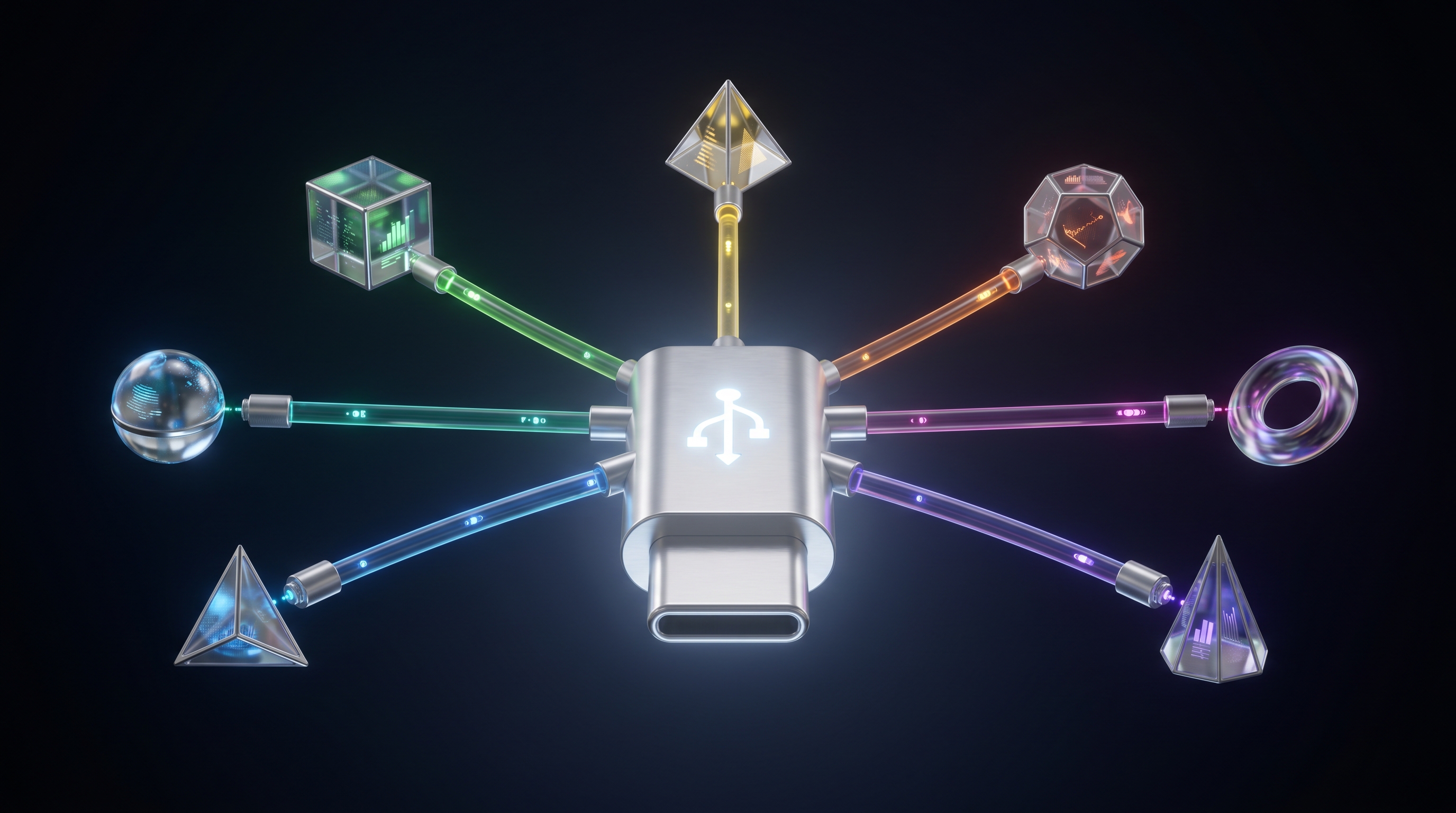
The Model Context Protocol (MCP) is an open standard that defines a universal interface for connecting AI models to external tools, data sources, and services. Originally developed by Anthropic and announced in November 2024 [1], MCP has rapidly evolved into the dominant interoperability layer for agentic AI — often described as the "USB-C of AI integrations" [2]. By April 2026, the protocol has crossed 97 million monthly SDK downloads, supports over 10,000 public servers, and is governed by the Linux Foundation's Agentic AI Foundation (AAIF) with backing from Anthropic, OpenAI, Google, Microsoft, AWS, and Cloudflare [3][4].
MCP solves a fundamental problem: without a shared protocol, every AI application must build bespoke integrations for every external system it needs to access. MCP replaces this N×M integration matrix with a single standardized contract built on JSON-RPC 2.0, enabling any compliant client to discover and use any compliant server's capabilities at runtime [5].
2. Architecture
MCP uses a three-layer architecture with clearly separated roles:
graph TD
    subgraph Host["Host (AI Application)"]
        C1[MCP Client 1]
        C2[MCP Client 2]
        C3[MCP Client N]
    end

    C1 <-->|JSON-RPC 2.0| S1[MCP Server A<br/>e.g. Filesystem]
    C2 <-->|JSON-RPC 2.0| S2[MCP Server B<br/>e.g. GitHub API]
    C3 <-->|JSON-RPC 2.0| S3[MCP Server C<br/>e.g. Database]

    S1 --- D1[(Local Files)]
    S2 --- D2[GitHub REST API]
    S3 --- D3[(PostgreSQL)]
Roles
| Role | Description |
|---|---|
| Host | The AI application (e.g., Claude Desktop, Cursor, a custom agent) that orchestrates the session. A host creates and manages one or more MCP clients. |
| Client | A connector within the host that maintains a 1:1 stateful session with a single MCP server. Handles capability negotiation, request routing, and lifecycle management. |
| Server | A lightweight program that exposes specific capabilities — tools, resources, and prompts — to the client. The server knows nothing about the host's internal implementation. [5][6] |
Lifecycle
- Initialization — The client sends an
initializerequest declaring its supported protocol version and capabilities. The server responds with its own capabilities. - Capability Negotiation — Both sides agree on the intersection of supported features (tools, resources, prompts, sampling, roots, elicitation).
- Operation — The client discovers and invokes server capabilities via JSON-RPC requests (
tools/list,tools/call,resources/read, etc.). - Shutdown — Either side can terminate the session gracefully. [5]
3. The Three Primitives
MCP servers expose capabilities through three core primitives, each serving a distinct purpose in the agent's reasoning loop:
3.1 Tools
Tools are executable functions that the AI model can invoke to perform actions — querying databases, calling APIs, running computations, or manipulating files. Each tool is uniquely identified by a name and described by a JSON Schema defining its input parameters [7].
{
  "name": "search_products",
  "description": "Search the product catalog by keyword",
  "inputSchema": {
    "type": "object",
    "properties": {
      "query": { "type": "string" },
      "limit": { "type": "integer", "default": 10 }
    },
    "required": ["query"]
  }
}
Tools return structured content (text, images, audio, resource links, or embedded resources) with optional annotations for audience, priority, and timestamps. The 2025-06-18 spec added structured tool output, allowing servers to define an outputSchema so clients can programmatically parse results [8].
The 2025-11-25 spec introduced experimental Tasks support — any tool call can now return a task handle, enabling "call-now, fetch-later" patterns for long-running operations [9].
3.2 Resources
Resources are data sources the agent can read for context — files, logs, database records, API responses, configuration documents. Unlike tools, resources are not actions; they represent what the AI can know rather than what it can do. This distinction shapes how agents reason about available information [6].
Resources are identified by URIs and can be:
- Listed via
resources/listfor discovery - Read via
resources/readto fetch content - Subscribed to for change notifications
3.3 Prompts
Prompts are reusable templates that structure interactions with language models. Instead of hardcoding system prompts in the application layer, servers expose them through MCP, enabling different agents to discover and use the same high-quality prompt engineering without duplication across codebases [6].
Prompts support parameterization and can include multi-turn message sequences, making them useful for few-shot examples, system instructions, and workflow templates.
4. Client-Side Features
MCP is not purely server-to-client. Clients can offer features back to servers:
| Feature | Description |
|---|---|
| Sampling | Server-initiated LLM interactions — the server can request the client to run an inference, enabling recursive agentic behaviors. Users must explicitly approve sampling requests. [5] |
| Roots | Server-initiated queries about filesystem or URI boundaries the server should operate within. |
| Elicitation | Server-initiated requests for additional information from the user (added in 2025-06-18), including URL-mode elicitation for OAuth flows (added in 2025-11-25). [8][9] |
5. Transport Layer
MCP separates the data layer (JSON-RPC messages) from the transport layer (how those messages are delivered). The protocol currently defines two production transports, with a third deprecated:
5.1 stdio (Standard I/O)
The client spawns the MCP server as a child process and communicates over standard input/output streams. Zero network overhead, zero infrastructure, perfect process isolation [6][10].
Use when: The server runs on the same machine as the client — CLI tools, desktop applications, local development.
sequenceDiagram
    participant Client as MCP Client
    participant Server as MCP Server (child process)
    Client->>Server: spawn process
    Client->>Server: JSON-RPC via stdin
    Server->>Client: JSON-RPC via stdout
    Client->>Server: close stdin
    Server-->>Client: process exits
5.2 Streamable HTTP (Recommended for Remote)
Introduced in the 2025-03-26 specification, Streamable HTTP is the recommended transport for remote MCP servers. The client sends JSON-RPC requests as HTTP POST to a single endpoint (e.g., /mcp), and the server responds with either a standard JSON response or an SSE stream for streaming results [10][11].
Key advantages over legacy SSE:
- Works through firewalls, load balancers, and CDNs without special configuration
- Single endpoint instead of separate SSE and POST endpoints
- Supports both stateful (session-based) and stateless operation
- Compatible with standard HTTP authentication (OAuth, bearer tokens, API keys)
- Can be deployed on serverless platforms (AWS Lambda, Cloudflare Workers) [11][12]
5.3 SSE (Deprecated)
The original Server-Sent Events transport required two separate endpoints — one for the SSE stream and one for client-to-server POST requests. It was deprecated in the 2025-03-26 spec in favor of Streamable HTTP. Legacy SSE is still supported by some clients for backward compatibility, but new integrations should use Streamable HTTP [10][11].
Transport Comparison
| Transport | Topology | Session State | Infrastructure | Best For |
|---|---|---|---|---|
| stdio | Local (same machine) | Process lifetime | None | CLI tools, desktop apps, local dev |
| Streamable HTTP | Remote (network) | Optional (session headers) | HTTP server | Cloud services, multi-client, production |
| SSE (deprecated) | Remote (network) | Connection lifetime | HTTP + SSE server | Legacy integrations only |
WebSocket transport has been proposed for long-lived bidirectional connections with session persistence, but is not yet in the spec as of early 2026 [6].
6. Specification Evolution
The MCP spec has gone through four major revisions, each driven by real-world adoption feedback:
| Version | Date | Key Changes |
|---|---|---|
| 2024-11-05 | Nov 2024 | Initial stable release. Core primitives (tools, resources, prompts), stdio and SSE transports, JSON-RPC 2.0 messaging. [8] |
| 2025-03-26 | Mar 2025 | Streamable HTTP replaces SSE as recommended remote transport. Deprecation of legacy SSE. [10][11] |
| 2025-06-18 | Jun 2025 | Structured tool output. OAuth Resource Server classification with RFC 8707 Resource Indicators. Elicitation. Resource links. Removed JSON-RPC batching. [8][13] |
| 2025-11-25 | Nov 2025 | Experimental Tasks (async call-now, fetch-later). OpenID Connect Discovery. Icons metadata. Incremental scope consent. Client ID Metadata Documents (CIMD). Enterprise-managed authorization. Machine-to-machine auth. [9][14][15] |
Security Progression
Security has been a major focus of the spec's evolution:
- Pre-2025-06: API-key-based authentication — simple but limited.
- 2025-06-18: OAuth 2.1 with PKCE enforcement, HTTPS required. MCP servers classified as OAuth Resource Servers with RFC 8707 Resource Indicators to prevent token misuse across servers [13][16].
- 2025-11-25: Client ID Metadata Documents for safer client identification. Enterprise-managed authorization allowing IT admins to pre-authorize trusted agents through centralized identity providers. Cross-App Access (XAA) for multi-tenant scenarios [14][15].
7. SDKs and Developer Tooling
Official SDKs
The MCP project maintains official SDKs in multiple languages, all implementing the full protocol lifecycle:
| SDK | Repository | Maturity |
|---|---|---|
| TypeScript | modelcontextprotocol/typescript-sdk | Production — most mature, reference implementation |
| Python | modelcontextprotocol/python-sdk | Production — widely used for data/ML servers |
| Java | modelcontextprotocol/java-sdk | Stable |
| Kotlin | modelcontextprotocol/kotlin-sdk | Stable |
| C# | modelcontextprotocol/csharp-sdk | Stable |
| Ruby | modelcontextprotocol/ruby-sdk | Stable |
| Go | Community-maintained | Stable [17][18] |
Developer Tools
- MCP Inspector — Interactive debugging tool for testing MCP servers. Connects to a server and lets you browse tools, resources, and prompts, invoke them, and inspect JSON-RPC traffic [19].
- MCP Registry — The official community-driven registry at
registry.modelcontextprotocol.iofor discovering and publishing MCP servers [19][20]. - Debugging Guide — Comprehensive troubleshooting documentation for MCP integrations [19].
8. Ecosystem (2026)
Client Adoption
As of early 2026, MCP client support is widespread across the AI tooling landscape:
- Claude (Anthropic) — Native MCP client, the original reference implementation
- Claude Code — Uses MCP for tool integrations in the CLI agent
- Cursor — IDE with built-in MCP server support
- OpenAI Agents SDK — Supports hosted MCP, Streamable HTTP, and stdio servers [21]
- GitHub Copilot — MCP server registry and tool catalog integration
- LangChain, AutoGen, CrewAI — Open-source agent frameworks with MCP adapters [22]
Server Ecosystem
The server ecosystem has exploded. Key categories include:
- Developer tools — GitHub, GitLab, Sentry, Linear, Jira
- Data & databases — PostgreSQL, SQLite, MongoDB, Elasticsearch
- Communication — Slack, Discord, email
- File systems — Local filesystem, S3, Google Drive
- Web & search — Brave Search, Firecrawl, Puppeteer
- Knowledge — Obsidian, Notion, Confluence
Multiple discovery platforms compete: the official MCP Registry, GitHub's awesome-mcp-servers lists, Smithery, mcp.so, and various curated directories — some tracking 8,000+ entries [20][23].
Governance: Agentic AI Foundation (AAIF)
On December 9, 2025, Anthropic donated MCP to the newly formed Agentic AI Foundation (AAIF), a directed fund under the Linux Foundation [4][24]. The AAIF provides vendor-neutral stewardship for:
- MCP — The universal protocol for agent-tool communication
- goose — An open-source, local-first AI agent framework (contributed by Block)
- AGENTS.md — A standard for declaring agent capabilities (contributed by OpenAI)
Platinum members include AWS, Google, Microsoft, OpenAI, Anthropic, Cloudflare, Block, and others. The move mirrors the governance model that helped Linux, Kubernetes, and PyTorch scale through transparent, community-driven evolution [4][24][25].
9. Building an MCP Server (Minimal Example)
A minimal Python MCP server exposing a single tool:
from mcp.server.fastmcp import FastMCP

mcp = FastMCP("demo-server")

@mcp.tool()
def add(a: int, b: int) -> int:
    """Add two numbers together."""
    return a + b

if __name__ == "__main__":
    mcp.run(transport="stdio")
A client (e.g., Claude Desktop) discovers this tool at runtime via tools/list, sees the auto-generated JSON Schema from the type hints, and can invoke it via tools/call — no hardcoded integration required [6][17].
10. Key Takeaways
-
MCP is the de facto standard for connecting AI agents to external systems in 2026, with industry-wide adoption across Anthropic, OpenAI, Google, Microsoft, and the broader open-source ecosystem.
-
Three primitives cover the design space: Tools (actions), Resources (context), and Prompts (templates) provide a clean separation of concerns for agent capabilities.
-
Streamable HTTP is the future of remote transport, replacing SSE with a simpler, more infrastructure-friendly approach. stdio remains the optimal choice for local servers.
-
Security has matured rapidly — from API keys to OAuth 2.1 with PKCE, Resource Indicators, enterprise-managed authorization, and machine-to-machine auth in under a year.
-
Neutral governance under the Linux Foundation's AAIF ensures the protocol evolves as a community standard rather than a single-vendor project.
-
The ecosystem is vast but fragmented — with 10,000+ servers and multiple competing registries, discovery and quality curation remain active challenges.
-
The spec continues to evolve — experimental Tasks support, WebSocket transport proposals, and deeper OAuth integration signal that MCP is still in its rapid growth phase.
References
[1] Anthropic, "Introducing the Model Context Protocol," November 2024. https://www.anthropic.com/news/model-context-protocol
[2] SparkCo, "Why Model Context Protocol Became the USB-C of AI Agents," 2026. https://sparkco.ai/blog/mcp-in-2026-why-model-context-protocol-became-the-usb-c-of-ai-agents
[3] MarsDev, "MCP (Model Context Protocol): Developer Guide [2026]," 2026. https://www.marsdevs.com/blog/model-context-protocol-mcp
[4] Linux Foundation, "Announces the Formation of the Agentic AI Foundation (AAIF)," December 2025. https://www.linuxfoundation.org/press/linux-foundation-announces-the-formation-of-the-agentic-ai-foundation
[5] Model Context Protocol, "Specification — Latest," https://modelcontextprotocol.io/specification/latest
[6] ByteIota, "Model Context Protocol: Complete Developer Implementation Guide 2026," April 2026. https://byteiota.com/model-context-protocol-complete-developer-implementation-guide-2026/
[7] Model Context Protocol, "Tools — Server Specification," https://modelcontextprotocol.io/specification/latest/server/tools
[8] Model Context Protocol Info, "Specification Versions," https://modelcontextprotocol.info/specification/
[9] WorkOS, "MCP 2025-11-25 Spec Update: Async Tasks, Better OAuth, Extensions," 2025. https://workos.com/blog/mcp-2025-11-25-spec-update
[10] APIGene, "MCP SSE vs Stdio: Transport Options Explained (2026)," 2026. https://apigene.ai/blog/mcp-sse-vs-stdio
[11] fka.dev, "Why MCP Deprecated SSE and Went with Streamable HTTP," June 2025. https://blog.fka.dev/blog/2025-06-06-why-mcp-deprecated-sse-and-go-with-streamable-http/
[12] Fast.io, "MCP Streamable HTTP Transport Guide," 2026. https://fast.io/resources/mcp-streamable-http-transport/
[13] DasRoot, "Securing Model Context Protocol: OAuth, mTLS, Zero Trust," February 2026. https://dasroot.net/posts/2026/02/securing-model-context-protocol-oauth-mtls-zero-trust/
[14] Aaron Parecki, "Client Registration and Enterprise Management in the November MCP Spec," November 2025. https://aaronparecki.com/2025/11/25/1/mcp-authorization-spec-update
[15] Auth0, "MCP November 2025 Specification Update," 2026. https://auth0.com/blog/mcp-november-2025-specification-update.md
[16] Alibaba Cloud, "Comprehensive Analysis of New Features in the MCP Specification," 2025. https://www.alibabacloud.com/blog/602206
[17] Model Context Protocol, "Build an MCP Client — Quickstart," https://modelcontextprotocol.io/quickstart/client
[18] Stainless, "MCP SDK Comparison: Python vs TypeScript vs Go," https://www.stainless.com/mcp/mcp-sdk-comparison-python-vs-typescript-vs-go-implementations
[19] Model Context Protocol Info, "Tools — MCP Registry, Inspector, Debugging," https://modelcontextprotocol.info/tools/
[20] GitHub, "modelcontextprotocol/registry," https://github.com/modelcontextprotocol/registry
[21] OpenAI, "Model Context Protocol (MCP) — OpenAI Agents SDK," https://openai.github.io/openai-agents-js/guides/mcp
[22] Web4Agents, "Model Context Protocol (MCP) — Docs," February 2026. https://web4agents.org/en/docs/mcp
[23] APIGene, "MCP Marketplace Guide: Find the Right Server (2026)," 2026. https://apigene.ai/blog/mcp-marketplace
[24] WindowsForum, "MCP Joins Linux Foundation AAIF," December 2025. https://windowsforum.com/threads/mcp-joins-aaif-under-linux-foundation-to-standardize-agent-interoperability.393291/
[25] Gend.co, "OpenAI & Linux Foundation Launch Agentic AI Foundation," December 2025. https://www.gend.co/blog/openai-agentic-ai-foundation-linux