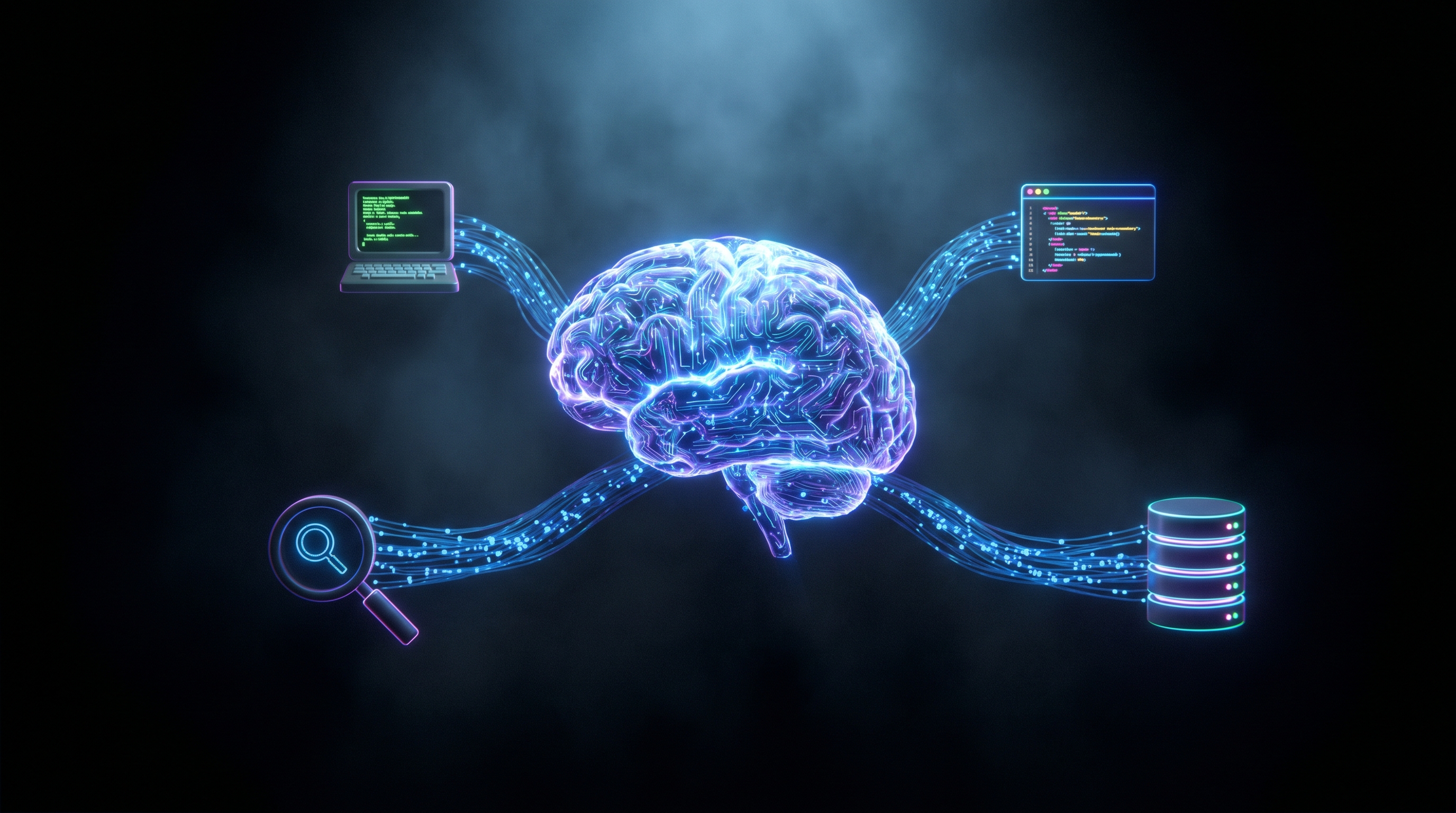
How AI Agents Work
Introduction
An AI agent is an LLM-powered system that can reason about a goal, decide on actions, and invoke external tools, APIs, and data sources to accomplish tasks on behalf of a user [2]. Unlike a one-shot chatbot that replies with text, an agent operates in a closed loop: it observes the state of its environment, plans its next move, executes that move through tools, and updates its reasoning based on the result. Over the 2023–2026 period this loop has evolved from a prompting trick into a production discipline with its own protocols, frameworks, memory architectures, and autonomy taxonomies [5][6].
This document covers the fundamentals that every practitioner should understand: the perception–plan–act loop, the ReAct paradigm that dominates modern agent design, tool use and the Model Context Protocol, the spectrum of autonomy levels, and the 2026 state of the art including reflection, self-evolution, and deep multi-agent systems.
The Perception–Plan–Act Loop
The classical agent loop predates LLMs and comes from decades of work in robotics and symbolic AI: sense the world, decide what to do, act, repeat. Modern LLM agents extend this loop by using a generative model as the reasoning substrate that decides between actions [6].
In production practice, teams typically decompose the loop into five stages rather than three, adding reflection and memory as explicit components [11]:
- Perception — ingest the user request and relevant environmental signals (file contents, API responses, sensor data, previous conversation turns).
- Planning — decompose the goal into steps, decide what information is missing, and choose the next action.
- Execution — invoke a tool, call an API, run code, or emit a message.
- Reflection — evaluate whether the last action moved the agent closer to the goal, detect errors, and revise the plan.
- Memory — persist useful state (episodic traces, learned skills, distilled facts) so the agent improves across turns and sessions.
Each stage maps to a distinct system component with its own failure modes and scaling characteristics. Perception fails when context windows overflow; planning fails when goals are ambiguous; execution fails on brittle APIs and rate limits; reflection fails when the model cannot honestly diagnose its own mistakes; memory fails when retrieval returns stale or irrelevant content [11]. Teams building real systems therefore treat each stage as a first-class engineering surface rather than leaving it implicit in a prompt.
ReAct: The Architectural Standard
The dominant single-agent pattern is ReAct — Reasoning + Acting — introduced by Yao et al. at ICLR 2023 [1][7]. ReAct interleaves chain-of-thought reasoning with tool invocation in a tight iterative loop, formalizing the agent’s behavior as a sequence of Thought → Action → Observation triples [3][8].
Each iteration proceeds as follows [4]:
- Thought: the model reasons explicitly about the current state, what is known, what is missing, and which tool to call next. This externalizes the model’s working memory so humans can inspect it.
- Action: the model emits a concrete tool invocation, such as
search[query],lookup[term], or a typed function call. - Observation: the result of the tool is returned to the model and appended to the context.
- The loop repeats until the agent emits a terminating action (
finish[answer]) or hits a stop condition like max iterations.
This design solves a specific problem: pure chain-of-thought reasoning hallucinates because it is not grounded in external facts, while pure action generation produces brittle plans because it never reasons about why a step is needed [8][3]. By interleaving the two, ReAct grounds reasoning in real observations and makes tool-use decisions interpretable and debuggable [3].
ReAct in 2026: What Has Changed
ReAct remains the architectural default, but several 2025–2026 shifts have reshaped how it is implemented [3][8]:
- Internalized reasoning. Frontier reasoning models — OpenAI o3/o4-mini, DeepSeek-R1, Gemini 2.5 Pro Thinking, Claude 4 Sonnet with extended thinking, Qwen3 Thinking — are trained with reinforcement learning on verifiable rewards (RLVR) so that Thought → Action → Observation cycles happen inside the model’s hidden reasoning traces [3]. The practical consequence is that prompts for ReAct can now be stripped down to (a) a role, (b) tool schemas, and (c) stop conditions, letting the model reason natively rather than being choreographed token by token [3].
- Parallel tool calls. Modern tool-calling APIs from OpenAI, Anthropic, and Google emit multiple tool calls in a single step. The strict sequential T→A→O trace is replaced by a DAG of concurrent invocations, and agent runtimes (LangGraph 0.3+, OpenAI Agents SDK, Pydantic-AI) support concurrent dispatch with per-call timeouts by default [3].
- Hybrid approaches. Combining ReAct with self-consistency outperforms either alone — on HotpotQA, ReAct+SC achieved 78.5% versus ReAct-only at 69.4% [4]. The lesson is that external grounding and internal knowledge are complementary.
- When not to use ReAct. ReAct context grows linearly with trajectory length, so long-horizon agents (100+ steps) benefit from Plan-and-Execute, hierarchical memory, or explicit state-machine graphs instead [3][7]. Plan-and-Execute generates a full plan upfront and is preferred for workflows with clear sequential dependencies such as data pipelines or deployment flows, where governance and predictability matter more than adaptiveness [2][7].
The broader industry has also moved from myopic single-loop solvers toward hierarchical and search-based systems, and from open-ended multi-agent chat loops toward explicit workflow graphs with typed handoffs [6].
Tool Use and the Model Context Protocol
Tool use is the pattern that turns a language model into an agent. Almost every production agent uses it, and it is the bridge between language and the outside world [14][6]. A tool is any external function an agent can invoke: a web search, a database query, a code interpreter, an email sender, a deployment trigger.
Good tool design in 2026 follows three principles [11]:
- Tools should be narrow and composable — each one does a single thing well, and complex behaviors emerge from composition.
- Tool descriptions must be precise enough for the LLM to select correctly without trial and error — ambiguous descriptions are a leading cause of agent failure.
- Every tool must return structured output with metadata — execution time, data freshness, error codes, and suggested next steps.
Production systems also mark tools with real-world side effects (sending email, committing code, making purchases) as high-consequence and gate them behind a requires_confirmation: true flag that triggers a human-in-the-loop check [5].
The Model Context Protocol (MCP)
Until 2024, every agent framework invented its own tool-binding format. In late 2024 Anthropic released the Model Context Protocol, an open JSON-RPC 2.0 standard for how AI agents discover and invoke external tools [9][12]. MCP has since been adopted by OpenAI, Google, Microsoft, and dozens of tool vendors, becoming the dominant standard for agent-to-tool communication [12].
Architecturally, MCP defines three roles inspired by the Language Server Protocol [12]:
- Hosts — LLM applications that initiate connections (Claude Desktop, Cursor, VS Code Copilot).
- Clients — connectors within the host that speak the protocol.
- Servers — services that expose tools, resources, and prompts.
Tools are model-controlled: the server exposes them with the intention that the AI model will automatically invoke them, usually with a human-in-the-loop approval step [14]. Clients discover tools through a tools/list endpoint and invoke them through tools/call [14]. The November 2025 specification added structured tool outputs with output schemas, tool annotations, and elicitation for human-in-the-loop flows, while March 2025 introduced OAuth 2.1 and replaced the older HTTP+SSE transport with Streamable HTTP to make remote, production-grade deployments viable [12].
The net effect: MCP is becoming the “last-mile standard” for agents the way USB became the last-mile standard for peripherals. An MCP server written once can be consumed by Claude, GPT, Gemini, Llama, or any model with tool-use support [9].
Autonomy Levels
Not all agents are equally autonomous, and choosing the right level is a deployment decision, not a capability decision. Anthropic popularized a six-level framework analogous to SAE levels for self-driving cars [10]:
| Level | Name | Description | Example |
|---|---|---|---|
| L0 | No AI | Purely human-controlled software | Traditional scripts, forms |
| L1 | AI-assisted | AI suggests; human decides and acts | Copilot autocomplete |
| L2 | AI-driven | AI acts; human reviews before execution | AI drafts PR; developer approves |
| L3 | Semi-autonomous | AI executes with selective HITL checkpoints | Coding agent runs tests autonomously, asks before merging |
| L4 | Autonomous | AI executes end-to-end; human monitors | Agent deploys a full feature with no human steps |
| L5 | Fully autonomous | AI self-directs, self-corrects, self-improves | Research-stage only |
Most production agents in 2026 operate at L2–L3. L4 exists in narrow, well-bounded domains like automated trading and data pipelines. L5 remains theoretical and raises alignment concerns [10]. Practitioners confirm the same pattern from the field — nearly every production system sits at supervised or monitored autonomy, not because higher levels are impossible but because the risk profile of enterprise tasks does not justify them [11].
A complementary principle has emerged: calibrated human oversight. Rather than being a binary on/off switch, oversight is expressed as milestone confirmation — the agent runs autonomously between defined checkpoints and pauses for human review at the end of each major phase [5]. This captures most of the productivity gain of full autonomy while keeping humans in the loop where it matters most.
Memory, Reflection, and Self-Improvement
A first-generation ReAct agent has no memory beyond its current context window. The 2023 Reflexion framework by Shinn et al. added verbal reinforcement learning: after a failed attempt, the agent writes a natural-language critique of what went wrong, stores it in an episodic memory buffer, and prepends it to the context on the next attempt [13][15]. The model’s weights never change, but its behavior does, because it is effectively learning from experience replay in natural language [15].
Reflexion has three components [13][15]:
- Actor — generates trajectories using ReAct-style reasoning, augmented with prior reflections.
- Evaluator — scores the actor’s output against the task objective.
- Self-reflection module — produces a verbal critique such as “I searched too broadly and missed the specific detail” or “I should have verified the intermediate result before proceeding.”
Through 2025–2026 this pattern has matured into a full ecosystem of self-evaluation techniques: Language Agent Tree Search (LATS) combining Monte Carlo tree search with reflection, Process Reward Models (PRMs) that score each intermediate reasoning step rather than just the final output, and multi-agent debate architectures where internal personas challenge each other’s logic [15]. Gartner projects that 40% of enterprise applications will integrate task-specific AI agents by the end of 2026, and the organizations that scale successfully are those layering reflection with evaluation, orchestration, and human oversight [15].
A further frontier is self-evolving agents, built on three pillars — persistent memory, learned skills, and a searchable history of interactions [16]. Teams have observed agents resolving tasks 40% faster after a month of operation than in their first week, as long-term memory accumulates reusable patterns [11]. Research frameworks like ARC (Active and Reflection-driven Context management) and dual-process memory architectures inspired by Kahneman treat context as a dynamically managed internal state rather than a passive transcript, enabling the agent to reorganize its working memory on the fly [17].
The 2026 State of the Art
Several patterns define the frontier as of 2026:
- Deep agents and long-running autonomy. Frameworks like LangChain’s Deep Agents (launched March 2026) provide production abstractions for agents that run for days, with a planning layer that generates task DAGs before execution, sub-agents with their own planning loops, and durable checkpointing for crash recovery [5]. Research systems like DeepAgent add autonomous tool discovery and a memory-folding mechanism that compresses past interactions into structured episodic, working, and tool memories, reducing error accumulation on long-horizon tasks [18].
- Multi-agent orchestration as workflow graphs. The industry has shifted away from unstructured agent-to-agent chat loops toward explicit workflow graphs with typed handoffs, improving observability and debuggability [6]. The orchestrator–subagent pattern — where an orchestrator decomposes a goal, delegates subtasks to specialists, collects results, and synthesizes output — is now the most common multi-agent topology [5].
- Typed, governable tool interfaces. Modern systems treat every tool invocation as strongly typed, versioned, and governable. Budgeted autonomy — explicit quotas on tokens, reasoning time, tool calls, and cost — is treated as a first-class invariant to bound operational risk [6].
- Code-as-action and computer use. The action paradigm has expanded beyond constrained JSON function calls to include code-as-action (the agent writes and executes Python) and computer-use actions (the agent drives a GUI). Verification and recovery are now first-class design requirements because these action types have broader blast radius [6].
- A mature framework ecosystem. LangChain/LangGraph, AutoGen, CrewAI, the Claude Agent SDK, the OpenAI Agents SDK, and Microsoft Semantic Kernel cover the spectrum from simple pipelines to enterprise plugin architectures [10]. The practical advice is still to start with direct API + function calling before adopting a heavyweight framework [10].
Conclusion
AI agents are LLMs operating in a loop over an environment, grounded by tool use and increasingly shaped by memory and reflection. The perception–plan–act loop provides the conceptual spine; ReAct provides the architectural standard for a single iteration; MCP provides the protocol for tools; autonomy levels provide the deployment taxonomy; and reflection, long-term memory, and self-evolution provide the learning dynamics [1][6][10][12][15].
The unsolved problems are well-known: agents still enter unbounded loops, drift from objectives, and fail in ways that traditional services do not [6]. The response is not full autonomy but calibrated autonomy — narrow tools, typed interfaces, budgeted resources, milestone-based human oversight, and layered reflection [5][11]. As models become more capable, disciplined architecture becomes more important, because more capable models cause more damage when they fail [11]. The agents that matter in 2026 are not the most autonomous; they are the most reliable.
References
[1] Yao et al. — ReAct: Synergizing Reasoning and Acting in Language Models (ICLR 2023) — https://arxiv.org/abs/2210.03629 [2] The Complete Guide to AI Agent Architectures: ReAct, CoT, and Tool Use — https://dev.to/lukefryer4/the-complete-guide-to-ai-agent-architectures-react-cot-and-tool-use-4ab7 [3] ReAct Agents — Reasoning + Acting in One Loop (tutorialQ, 2026) — https://tutorialq.com/ai/single-agent/react-agents [4] ReAct: The Architecture That Unified Agentic Reasoning (Aakash Sharan, 2025) — https://aakashsharan.com/react-agent-architecture/ [5] The Architecture of Agency: A Deep Technical Guide to Agentic AI Systems in 2026 (NJ Raman, Medium) — https://medium.com/@nraman.n6/the-architecture-of-agency-a-deep-technical-guide-to-agentic-ai-systems-in-2026-9df63b37f6df [6] LLM Agent Taxonomy and Architecture Survey (arXiv 2601.12560) — https://arxiv.org/pdf/2601.12560 [7] AI Agent Planning: ReAct vs Plan and Execute for Reliability (By AI Team, 2025) — https://byaiteam.com/blog/2025/12/09/ai-agent-planning-react-vs-plan-and-execute-for-reliability/ [8] ReAct Pattern: Interleaving Reasoning and Action for LLM Agents (Michael Brenndoerfer, 2026) — https://mbrenndoerfer.com/writing/react-pattern-llm-reasoning-action-agents [9] Building AI Agents That Actually Work: MCP Servers and Tool Orchestration (dev.to, 2026) — https://dev.to/kennedyraju55/building-ai-agents-that-actually-work-mcp-servers-tool-orchestration-and-running-everything-f5 [10] What Is an AI Agent? Autonomy Levels, Components & Use Cases (Decode It, 2026) — https://decodeit.app/en/ai/guides/what-is-ai-agent [11] Designing Autonomous Agents with LLMs: Lessons Learned (Xcapit, 2026) — https://www.xcapit.com/en/blog/designing-autonomous-agents-llms-lessons [12] What Is MCP? A Practitioner's Guide to Model Context Protocol (Agentic Academy, 2026) — https://agentic-academy.ai/posts/mcp-deep-dive/ [13] Shinn et al. — Reflexion: Language Agents with Verbal Reinforcement Learning (NeurIPS 2023) — https://arxiv.org/abs/2303.11366 [14] Tools — Model Context Protocol specification — https://modelcontextprotocol.info/docs/concepts/tools/ [15] AI Agent Reflection and Self-Evaluation Patterns (Zylos Research, 2026) — https://zylos.ai/research/2026-03-06-ai-agent-reflection-self-evaluation-patterns [16] The Rise of Self-Evolving AI Agents (dev.to, 2026) — https://dev.to/hoomanaskari/the-rise-of-self-evolving-ai-agents-memory-skills-and-the-architecture-that-changes-everything-en [17] Towards Self-Evolving Agents: A Dual-Process Framework for Continual Context Refinement (MDPI Electronics, 2026) — https://www.mdpi.com/2079-9292/15/6/1232 [18] DeepAgent: A General Reasoning Agent with Scalable Toolsets (arXiv 2510.21618) — https://arxiv.org/abs/2510.21618v3
Content from web sources has been paraphrased and summarized for compliance with licensing restrictions.